Some days nothing has an obvious name. Not anxious exactly. Not sad exactly. Just heavy, in a way that doesn't come with a diagnosis attached. You know journaling is supposed to help with this. You've heard it enough times to feel guilty about not doing it. So you open a notes app, type "today was", and nothing else comes.
The journal prompts for mental health that actually help aren't the ones that ask you to rate your mood on a scale of one to ten. They're specific enough to catch whatever you're carrying, whether that's one clear problem or six smaller ones stacked on top of each other. Below are 25 of them, grouped by what's actually going on, and the research on why a specific question works when a blank page doesn't.
Why a specific prompt beats "just write what you feel"
Most journaling advice hands you a blank page and a vague instruction, then hopes something useful falls out. Research on expressive writing, the practice of putting feelings into words instead of holding them, tells a more complicated story. A meta-analysis of 146 randomized studies found that disclosing personal, emotional experiences produces a small, reliable improvement in wellbeing (Frattaroli, 2006). Nobody's life turns around from one entry.
The effect isn't the same for everyone, either. A 2023 study out of Cambridge tracked 152 people using a smartphone journaling app for 28 days. Journaling improved psychological wellbeing, but mainly for people who already had an average or higher tendency to reflect on their own experience (MacIsaac, Mushquash & Wekerle, 2023). For everyone else, the same app did less. What you're asked to reflect on, and how, seems to matter more than the fact that you sat down at all.
That's the part most journaling advice skips. Sitting with a feeling isn't enough on its own. Something has to ask you the right question about it.
When "just write it out" backfires
There's a specific way this goes wrong. Free-writing about a problem with no direction can slide into rumination instead of reflection: the same worry, circling, without moving anywhere new. Susan Nolen-Hoeksema and her colleagues spent years documenting this exact pattern. Unstructured dwelling on distress feeds negative thinking and gets in the way of solving the actual problem, rather than resolving it (Nolen-Hoeksema, Wisco & Lyubomirsky, 2008). A blank page with no direction is exactly the kind of room that pattern needs.
So the fix isn't writing less. It's writing, or speaking, toward something specific instead of just around it.
What makes a mental health journal prompt actually work
A prompt that works shares three things. It's specific: not "how do you feel" but "where in your body is this sitting right now." It has a stopping point: one sentence, five minutes, one honest answer, not an open invitation to keep going until you run dry. And it points somewhere: toward the feeling underneath, the pattern repeating itself, or the smallest next step, not back at the problem you already know is there.
The 25 prompts below are built on that shape. Find the group that matches where you are today.
25 journaling prompts for mental health, organized by what you're carrying
These work spoken aloud as well as written down. Often better. Speaking doesn't ask you to organize the thought before you let it out, so there's less room for the part of your brain that wants to edit, soften, or perform the answer instead of finding it.
When you can't name what's wrong
- What's the most honest word for how I'm feeling right now, even if it's not a proper "feelings" word?
- If this feeling had a temperature, would it be hot, cold, or numb?
- What actually happened in the last day that's connected to this?
- What am I telling myself right now that I haven't stopped to check is true?
- If I had to describe today in one sentence to someone who wasn't there, what would I say?
When you're carrying too much at once
- Of everything on my mind right now, which one thing actually needs me today?
- What's mine to solve here, and what have I picked up that belongs to someone else?
- If I could only keep doing one thing this week, what would it be?
- What am I pretending isn't tiring me out?
- What would "good enough" look like today, specifically?
When you're harder on yourself than you'd be on anyone else
- What would I say to a friend who told me exactly what I just told myself?
- What's the kindest true thing I could say about how I've handled this?
- Where did I learn that struggling with this means something's wrong with me?
- What did I do today that I'd give someone else credit for without hesitating?
- What does the part of me that's struggling actually need right now?
When the same thing keeps happening
- Where else in my life have I felt exactly this before?
- What's the pattern underneath this, not just this one version of it?
- What usually happens right before this feeling shows up?
- What have I tried before that actually helped, even a little?
- If this keeps happening, what might it be trying to tell me?
If overthinking is the shape this keeps taking, the loop-breaking prompts in Journal for Overthinkers go further into that specific mechanism.
When you need a way forward, not just a way to feel it
- What's the smallest next step, small enough that it feels almost too easy?
- What would I need to believe about myself to get through this week?
- What's one thing about today I want to remember six months from now?
- Who or what has actually helped me through something like this before?
- What would I do right now if I weren't afraid of getting it wrong?
Why speaking these works when writing stalls out
Writing asks you to organize a thought before it's finished, which is backwards when what you're trying to catch is messy and half-formed. Speaking doesn't make that demand. You can start a sentence without knowing how it ends, double back, contradict yourself, and still land somewhere true.
That's most of why these prompts work better out loud. You're not performing an answer. You're finding one.
Built for the days you can't name what's wrong
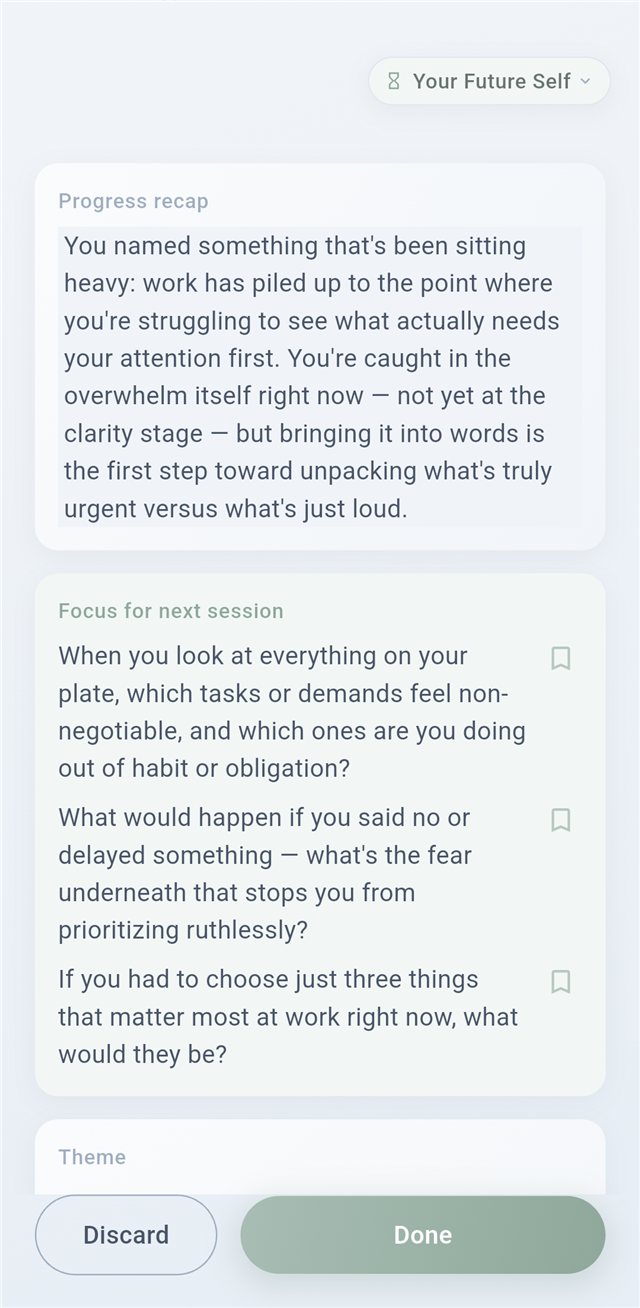
This is what Nagi does. You pick a guide (ten to choose from) and speak whichever prompt above actually landed. The guide listens, then asks the follow-up question you wouldn't have thought to ask yourself: the one that turns "I don't know what's wrong" into something you can finally look at.
The guide doesn't hand you a mood scale or a blank page. It hands you a question, and then the next one.
Frequently Asked Questions
What are good journal prompts for mental health?
Good ones share three things: they're specific, they end somewhere, and they point at something concrete instead of the mood itself. "How are you feeling" invites a shrug. "Where in your body is this sitting right now" gives you a place to start. If you're not sure which prompt to use today, pick the group above that matches what's actually happening, not the first item on the list.
How often should I use journal prompts for mental health?
There's no fixed number. The Cambridge study that found real benefits from app-based journaling ran for 28 days, and even then, the people who benefited most already had some habit of reflecting on their own experience, not the people journaling hardest. Consistency does more than intensity. A few honest minutes most days beats one long unloading once a month.
Should I write these prompts down or speak them out loud?
Either works, but if you've tried journaling before and the blank page stopped you every time, try speaking the prompt instead. Say it into your phone, into the air, into a guided app like Nagi. The answer tends to arrive faster when you're not also trying to make it look good on the page.